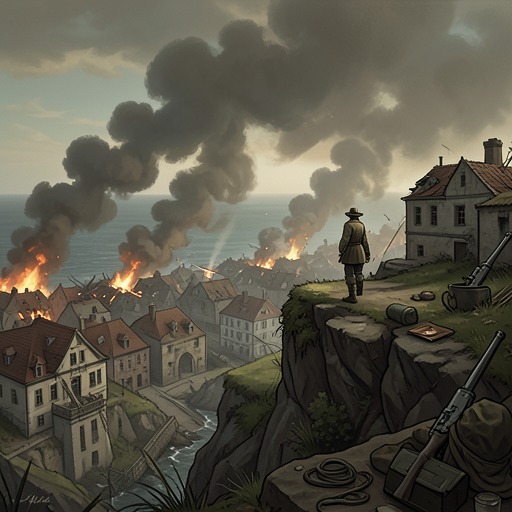
Saint-Malo under Nazi occupation
All the Light We Cannot SeeSaint-Malo under Nazi occupation is a city in which military rule enters ordinary life by degrees: through the surrender of radios, scrutiny of residents, demands for labor, and restrictions on movement. The city is not merely a backdrop to the siege. Its streets, homes, and channels of communication become instruments of control, while residents find limited, often concealed ways to resist.
Occupation in Daily Life
The occupation remakes the city gradually. Marie-Laure LeBlanc thinks that Saint-Malo is becoming like the model upstairs: streets emptied one by one, and ordinary trips outside newly charged with exposure. The quiet feels unnatural to her, and the possibility of unseen danger shapes how she experiences the windows above the street. The model offers a precise image of that change: the inhabited city appears to be shrinking into a miniature whose streets can be watched and whose population can be counted.
That counting becomes administrative fact when occupation authorities require every household to display a list of its occupants on the door. The posted notice identifies Etienne LeBlanc as sixty-two and Marie-Laure as fifteen. Such a list makes private households legible to the authorities, even as wartime scarcity narrows the choices within them. Marie-Laure imagines abundant meals, while a visit to the bakery brings her a loaf and a concealed message from Madame Ruelle. Food is both a scarce daily necessity and a cover for communication.
Control reaches into the domestic sphere through the radio-surrender order. Residents are told to deliver their receivers to 27 rue de Chartres by noon the following day; failure to comply carries the threat of arrest as saboteurs. The announcement turns possession of a household device into a matter of political suspicion. In the wider wartime setting, Frau Elena writes that listening to a foreign broadcast is a criminal offense in Germany and can lead to hard labor. That letter does not establish the local rules in Saint-Malo, but it places the city’s restrictions within a broader regime of control over information.
Policing, Labor, and Movement
The rules are enforced not only by German authorities but also through French officials and institutions. Two French policemen arrive at the LeBlanc home at the request of the Paris Natural History Museum and announce that a prisoner has been convicted of theft and conspiracy. They add that prisoners, whether political or otherwise, can be compelled to work even without a labor sentence. The exchange presents forced labor as an administrative procedure, while the people subject to it have little visible means of challenging the decision.
Daniel LeBlanc’s arrest shows how suspicion can attach to ordinary work and objects. Seized outside Vitré while traveling toward Paris, he is questioned first by French officers and then by Germans, who examine his notebook, tool case, seven skeleton keys, and small files and saws. He explains that he makes models for his daughter and that the keys belong to the museum where he works. The German interrogators appear to suspect a plot against the Château de Saint-Malo, but their questioning is more forceful than conclusive: they deny him paper, linens, and a telephone. His detention removes him from his family and leaves his explanations unable to reach those who might help.
Occupation measures also turn residents’ labor toward military preparation. After a German truck is destroyed on a bridge in a village south of Saint-Malo, the authorities blame terrorists and send police door to door to demand able-bodied men for work. They are assigned tasks that include digging trenches, unloading railway wagons, moving cement, and building obstacles on fields and beaches to strengthen the Atlantic Wall. Madame Ruelle reports that the authorities also attribute the attack to a network of anti-occupation radio broadcasts. Beaches are enclosed with wire and wooden chevaux de frise, and access to the walkways atop the ramparts is restricted.
As the siege approaches, movement is constrained more directly. Claude Levitte tells Marie-Laure that evacuation orders have been issued and that the city gates are locked. He reports that men between sixteen and sixty are being detained, ordered to assemble at the château tower, and then marched at low tide to Fort National. Marie-Laure does not confirm the report; she listens, then wonders whether Levitte has really spoken with Etienne. The uncertainty matters: even information about who is being taken and where they are going arrives through fragile personal channels rather than secure public knowledge.
Everyday Resistance and Communication
Resistance in Saint-Malo takes forms that can look almost domestic. Madame Ruelle, the baker’s wife, drives at dusk with Madame Guiboux and a stepladder secured to the roof of her husband’s car. Using a ratchet set, they rearrange road signs along the Route de Carentan, sending travelers toward misleading destinations. Their return to Number 4 rue Vauborel is described as a shared, laughing reprieve, but the act itself interferes with the occupation’s control of roads and directions.
Messages hidden in bread create another discreet route through the city. Madame Ruelle passes Marie-Laure a loaf with a folded paper beneath it; later, another message containing nine numbers is hidden inside bread for Etienne to find. The delivery depends on routine contact at the bakery, an ordinary exchange adapted to carry information. As pressure grows, Etienne recognizes that the messages may have become more important, not less, even while he and Marie-Laure must weigh the danger of continuing.
Radio makes that contest over information explicit. The occupation authorities order receivers surrendered, while radio transmissions are treated as a possible source of organized resistance. In the rubble, Werner Pfennig constructs a working set from the available materials: wire coiled around a pipe, a bent strut used to support an antenna, a diode, a battery, and an earphone. The improvised apparatus shows communication reduced to its physical essentials under siege. Its existence contrasts with the authorities’ effort to remove radios from civilian homes: control can restrict access to equipment, but it cannot make transmission impossible.
Resistance remains vulnerable to internal strain as well as outside policing. After an earlier search and dispute over activities conducted from the house, Etienne tells Madame Manec that he will support her but that she may no longer carry out those actions there or involve Marie-Laure. In the weeks that follow, Madame Manec remains outwardly courteous, yet becomes distant and sometimes disappears for half a day. Her memorial later gathers neighbors through food and shared attendance, while Etienne withdraws behind his door. The occupation’s pressure thus reaches beyond arrests and orders: it complicates relationships among people trying to decide what risks they can bear together.
Siege and Civilian Consequences
By the third afternoon of the siege, the city is under shellfire, and fires burn among its houses, trees, and cars. At Fort National, where 380 French prisoners are being held with minimal cover, an American field howitzer fires a single shell that is improperly ranged. It crosses the city walls and bursts against the northern parapet, killing nine prisoners. The episode makes clear that civilian and captive lives are endangered not only by the occupying force but also by the violence of the battle approaching the city.
For those sheltering in the city, survival is measured in small decisions as well as military developments. Marie-Laure asks her father how much food remains and says she wants to save it rather than eat. The exchange gives scarcity a household scale, set against the larger movement of troops and artillery. Elsewhere, people continue their ordinary tasks where they can; the city’s quiet streets and routines persist uneasily beside the threat of renewed shelling.
Significance
The occupation is depicted as a sequence of connected restrictions rather than a single decree: radios are surrendered, households listed, men recruited for construction work or detained, and movement through streets, beaches, and ramparts curtailed. Each measure changes what residents can do and what they can know. Yet the same everyday spaces that make people observable also offer cover for small acts of opposition: the bakery carries coded papers, a car carries a ladder for redirecting road signs, and a radio assembled from scraps restores a channel of transmission.
Saint-Malo’s experience therefore links private life to military administration without making resistance effortless or uniform. People differ over whether to continue, pause, or refuse dangerous work, and information remains incomplete even when the consequences are immediate. As the siege turns occupation into open bombardment, the city’s earlier restrictions acquire their full weight: they have already narrowed civilian choices before the shells arrive.